
Heart rate variability (HRV) is a primary method for assessing physiological readiness, autonomic nervous system function, and recovery[1], [2], [3]. However, capturing high-quality data daily often presents logistical challenges. While electrocardiography (ECG) chest straps provide unmatched beat-to-beat accuracy, optical (PPG) wearables offer an easier alternative, albeit with recognized limitations in data quality[4]. Furthermore, deploying wearable sensors across a large athletic roster or a clinical study introduces practical friction, including battery management, hardware maintenance, and user compliance.
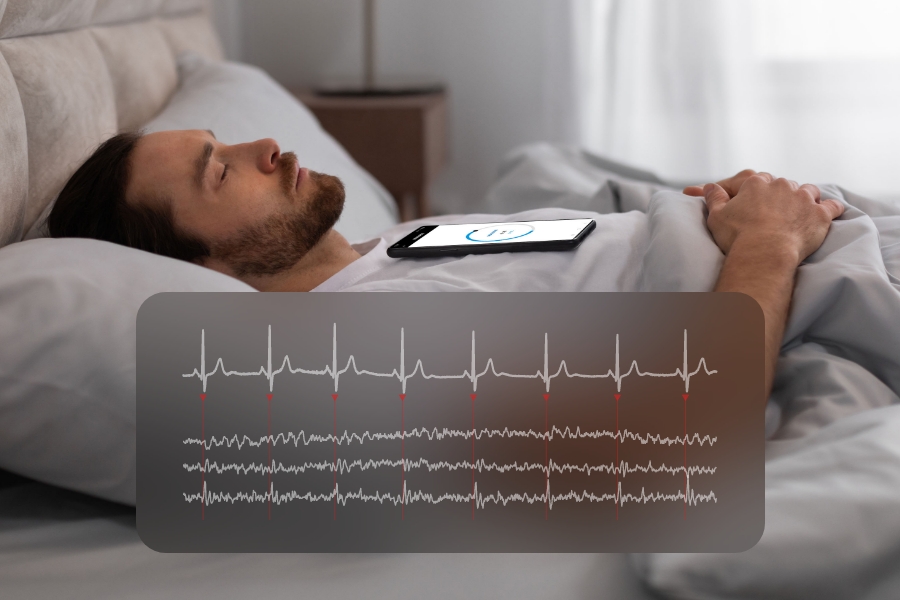
To address these challenges, our latest white paper validates a wearable-free methodology for readiness monitoring: smartphone-based seismocardiography (SCG)[5]. SCG captures the subtle mechanical vibrations generated by cardiac activity on the chest wall[6]. By placing a smartphone flat on the chest, the Kubios app leverages the built-in accelerometer to detect these micro-vibrations, translating them into standard HRV metrics—including mean heart rate (HR), RMSSD, and our proprietary PNS index—without the need for external sensors. For a general overview of how this technology works in practice, read our foundational guide on measuring HRV with your smartphone.
Validation study design
To evaluate the efficacy of this method, we conducted a rigorous validation study in collaboration with the University of Eastern Finland. The study included 57 healthy adult participants (aged 18–58 years).
We recorded resting HRV simultaneously using four different methods to assess how the smartphone-based SCG compares to established industry standards:
- Biopac MP150 ECG system (gold-standard reference device)
- Polar H10 (ECG chest strap)
- Polar Verity Sense (optical PPG armband)
- Smartphone-based SCG via the Kubios app (tested on both Apple and Samsung devices)
Agreement and data quality
The findings indicate that smartphone-based SCG provides highly reliable HRV data under controlled conditions. When participants were measured in a still, supine resting position, the smartphone-based SCG performed with high accuracy:
- High agreement with ECG: The Kubios app’s SCG metrics demonstrated excellent correlation with the gold-standard ECG across Mean HR, RMSSD, and the PNS index (r ≥ 0.99 for all). The mean absolute errors (MAE) were minimal, deviating from the ECG by an average of just 0.06 bpm for Mean HR, 2.0 ms for RMSSD, and 0.06 for the PNS index.
- Comparability to optical sensors: The smartphone method performed at a level directly comparable to established optical wearables, with RMSSD MAE of 2.0 ms versus 2.6 ms for the optical sensor, offering a viable alternative to external sensors. Because SCG relies on micro-vibrations, this accuracy is specifically achieved during resting measurements where the subject remains completely still and breathes normally.
- Low artifact correction rates: While SCG is inherently sensitive to mechanical movement, the requirement for automatic beat correction under resting conditions was low (averaging less than 0.7%). Minor movement-induced errors were effectively mitigated by the application’s built-in signal quality control algorithms.
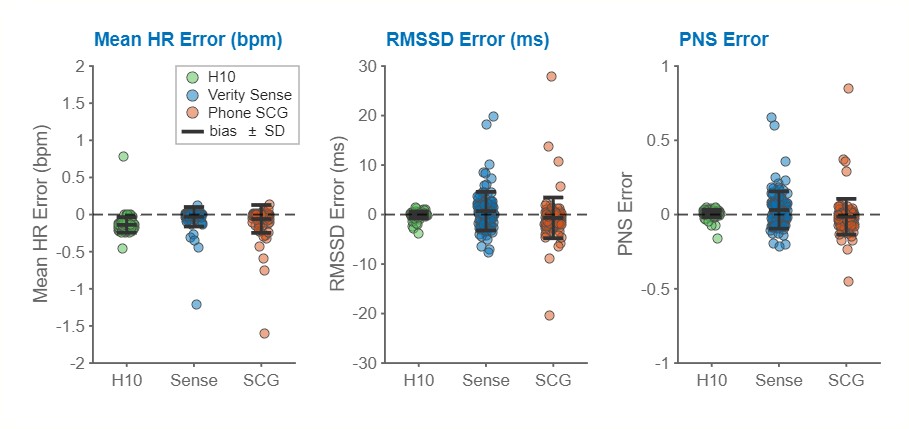
Figure: Device accuracy compared to the gold-standard ECG. The graphs display the measurement errors for Mean HR, RMSSD, and the PNS index across the Polar H10, Polar Verity Sense, and smartphone-based SCG.
Methodological considerations and hardware compatibility
While smartphone-based SCG provides a highly accessible method for HRV analysis, its accuracy relies on specific measurement conditions and hardware capabilities:
- Motion sensitivity: Because SCG measures mechanical vibrations, it is highly sensitive to movement artifacts. Even minor body movements, talking, or changes in posture can introduce signal disturbances. Reliable measurements require the user to remain completely still in a supine resting position for the duration of the recording; however, normal, spontaneous breathing does not interfere with the measurement.
- Smartphone compatibility: The Kubios SCG algorithm is robust and compatible with the vast majority of modern iOS and Android smartphones. During the beta testing phase of the smartphone-based SCG approach for daily readiness monitoring, we have observed that Apple devices consistently sample accelerometer data at 100 Hz, while Android models vary between 100 Hz and 500 Hz. The study confirmed that HRV estimation remains accurate across these varying sampling rates and phone models.
- Hardware limitations: In some older or lower-end Android devices, baseline accelerometer noise may be too high to permit reliable beat detection. To account for this, the Kubios application features an automated signal quality control mechanism that alerts the user if the signal is inadequate. In such cases, the recommended alternative is to utilize a standard Bluetooth heart rate strap.
Practical advantages of the SCG approach
Beyond the research-grade accuracy demonstrated under controlled resting conditions, the primary utility of smartphone-based SCG lies in its operational efficiency. For practitioners, researchers, and team personnel, this wearable-free methodology resolves several common barriers associated with longitudinal HRV tracking:
- Scalability for group monitoring: In team sports or large-scale research cohorts, relying on built-in smartphone sensors significantly reduces the logistical complexity of daily data collection. It eliminates the need for hardware distribution, device synchronization, and battery management across dozens of participants.
- Enhanced measurement compliance: By utilizing a device individuals already own and handle daily, the barrier to entry for routine morning measurements is substantially lowered. This streamlined, sensor-free protocol can promote higher compliance rates during long-term field studies and athletic monitoring.
- Resource-efficient deployment: Eliminating the requirement for dedicated external sensors—such as ECG straps or optical PPG armbands—provides a highly cost-effective alternative for wellness professionals and researchers managing multiple subjects simultaneously.
Ultimately, smartphone-based SCG bridges the gap between high-fidelity physiological measurement and real-world practical application, delivering reliable readiness metrics without the traditional hardware constraints.
Read the full validation study—For a comprehensive review of the methodology, statistical analysis, and comparative data, please refer to the complete white paper: 👉 Read the full White Paper here
Try the Kubios App—To utilize our scientifically validated, wearable-free HRV measurement protocol, download the application today: 👉 Download the Kubios App for iOS or Android
Frequently asked question (FAQ)
What exactly is seismocardiography (SCG), and how does my phone measure it?
SCG is a method of recording the mechanical vibrations of the heart. Every time your heart beats, it generates micro-vibrations across your chest wall. By placing your smartphone flat on your chest, the Kubios app uses the phone’s built-in accelerometer to detect these vibrations and accurately calculate your beat-to-beat intervals.
What is the accuracy of the smartphone-based SCG?
Under resting conditions, the accuracy is very high. Our validation study showed that SCG-derived HRV metrics (Mean HR, RMSSD, and PNS index) have a near-perfect correlation (r ≥ 0.99) with gold-standard ECG reference devices. The accuracy is directly comparable to established optical (PPG) sensors, provided the user remains completely still (while breathing normally) during the measurement.
Do I need a specific brand or model of smartphone to use this feature?
The Kubios SCG algorithm is robust and compatible with the vast majority of modern iOS and Android smartphones. In some older or lower-end Android devices, baseline accelerometer noise may be too high to permit reliable beat detection. To account for this, the Kubios application features an automated signal quality control mechanism that alerts the user if the signal is inadequate.
What happens if I accidentally move during the measurement?
The Kubios app features a built-in signal pre-processing mechanism, consisting of noise detection and beat correction algorithms. Movement periods or other beat detection errors are successfully captured by these pre-processing algorithms, ensuring that only good quality HRV data is analyzed. If the duration of the movement is long enough, the app will detect the poor signal quality and alert you that the measurement cannot be reliably analyzed. If this happens, you can simply repeat the measurement.
What to do if I consistently get poor quality alerts?
Consistently poor-quality data is typically due to either persistent movement artifacts or a low-end smartphone accelerometer sensor with high baseline noise. To improve signal quality, ensure you remain completely still (normal breathing is perfectly fine) and do not touch or hold on to your phone during the measurement. You can also try performing the measurement with a different smartphone if one is available. In the rare case that the app is still consistently unable to reliably analyze your data, we recommend using a standard Bluetooth heart rate sensor instead.
References
- Task force of the European society of cardiology and the North American society of pacing and electrophysiology. Heart rate variability – standards of measurement, physiological interpretation, and clinical use. Circulation, 93(5):1043–1065, March 1996.
- Berntson GG, Bigger Jr JT.,Eckberg DL, Grossman P, Kaufmann PG, Malik M, Nagaraja HN, Porges SW, Saul JP, Stone PH, and Van Der Molen MW. Heart rate variability: Origins, methods, and interpretive caveats. Psychophysiol, 34:623–648, 1997.
- Järvelin-Pasanen S, Sinikallio S, and Tarvainen MP. Heart rate variability and occupational stress–systematic review. Industrial Health, 56:500-511, 2018.
- Quigley KS, Gianaros PJ, Norman GJ, Jennings JR, Berntson GG, de Geus EJC. Publication guidelines for human heart rate and heart rate variability studies in psychophysiology-Part 1: Physiological underpinnings and foundations of measurement. Psychophysiology, Sep;61(9):e14604, 2024.
- Lipponen JA, Rana S, and Tarvainen MP. Validation of smartphone-based seismocardiography for heart rate variability analysis in the Kubios application. Kubios white paper. March, 2026.
- Taebi A, Solar BE, Bomar AJ, Sandler RH, and Mansy HA. Recent advances in seismocardiography. Vibration, 2(1):64-86, 2019.