
The study of heart rate variability (HRV) has long been a cornerstone of human physiological and psychological research [1]. However, since the 1990s, non-clinical cardiac studies in dogs have steadily increased, driven by a growing interest in canine behavior, mood, emotion, and welfare [2], [3].
Today, researchers, veterinary professionals, and advanced behaviorists use HRV to objectively measure stress, evaluate animal welfare, and uncover the deep emotional connections between dogs and their owners. But measuring a dog’s HRV is not as simple as attaching a sensor and running standard human algorithms
Canine cardiac function is uniquely adapted to their physiology. In this article, we will explore how a dog’s HRV differs from a human’s, why these differences demand specialized pre-processing tools, and how Kubios HRV Scientific is setting the gold standard for canine HRV analysis.
How canine HRV differs from human HRV
While the mammalian heart is regulated by the autonomic nervous system (ANS) across species, canine heart rate and HRV exhibit distinct physiological patterns compared to humans [3].
The most significant difference lies in respiratory sinus arrhythmia (RSA). In RSA, the heart rate naturally varies in synchrony with breathing—speeding up during inspiration and slowing down during expiration [4]. While humans also experience RSA, dogs exhibit a much more pronounced version, possessing an RSA that is three times greater than that of humans [5], [3]. This results in highly variable beat-to-beat intervals (RR intervals) and exceptionally high resting HRV [3]. As shown in the figure below, the magnitude of this natural beat-to-beat variation in a resting dog greatly exceeds that of a healthy human.
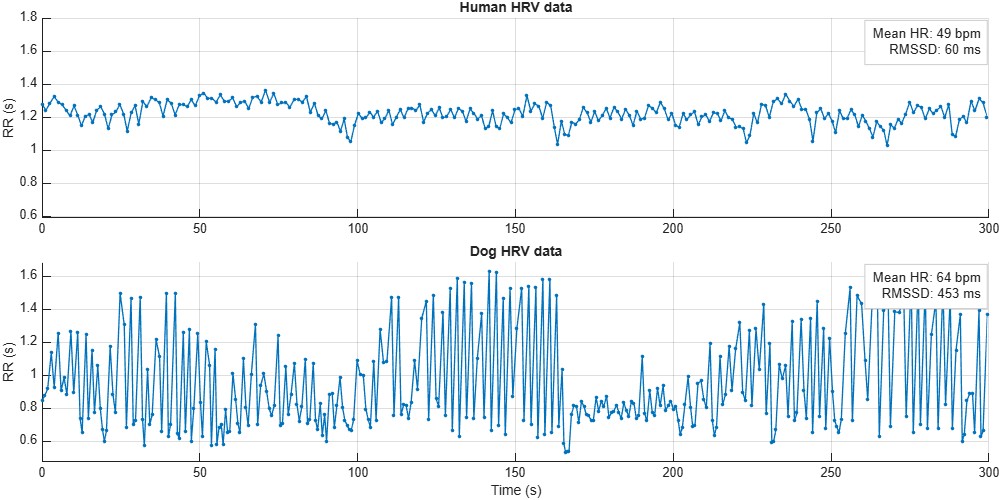
Figure: Comparison of resting HRV in a healthy young human male (top) and a dog (bottom).
Furthermore, dogs display unique behavioral breathing patterns that drastically impact their cardiac rhythms. For example, whether a dog is panting to cool down on a warm day or due to emotional arousal in an unfamiliar environment, their breathing frequency can elevate to 300–350 breaths per minute, which overrides the parasympathetic control (RSA) and leads to elevated heart rates and reduced HRV [3].
The challenge of analyzing canine data
Because a dog’s resting HRV is naturally massive compared to a human’s, standard HRV analysis software often misinterprets the data.
The high magnitude of canine HRV complicates ECG artifact correction [3]. In humans, a missed beat or a false detection creates an obvious outlier in the RR interval time series. In dogs, however, single missed or extra QRS detections do not always result in clear outlier RR intervals because the natural beat-to-beat variation is already so large [3]. Consequently, artifact correction algorithms intended for humans may misinterpret canine data [3].
To obtain accurate metrics, researchers need specialized tools designed exclusively to handle the unique physiological thresholds of canine cardiac data.
Validated pre-processing with Kubios HRV Scientific
To meet the specific needs of veterinary and canine behavioral researchers, Kubios adapted its widely used pre-processing algorithms to better accommodate the larger magnitude of canine HRV by modifying the detection thresholds [3].
The canine-specific analysis mode in Kubios HRV Scientific features these modified detection thresholds for both noise segment detection and automatic beat correction. Recent validation studies have demonstrated the high accuracy of these canine-specific tools:
- Noise detection: The algorithm accurately identifies and excludes corrupted segments of the HRV recording from analysis. When validated against expert-annotated canine data, the noise detection algorithm achieved a sensitivity of 97.15% and a specificity of 98.21% [3].
- Beat correction: The automatic beat correction algorithm accurately detects and corrects RR-interval outliers. In validation testing using simulated outliers inserted into canine data, the outlier detection algorithm reached a sensitivity of 82.20-94.32% [3].
Because of the extreme irregularity that can occasionally occur in short canine recordings—such as double-length RR intervals during intense sniffing—the recommended workflow also allows researchers to manually review and correct any remaining outliers if automatic detection fails, enhancing the reliability of the final data.
Practical applications of dog HRV
With accurate, validated tools available, the practical applications of canine HRV are expanding rapidly across research and training fields.
- Evaluating welfare and emotional arousal: Just as in humans, low HRV values in dogs generally indicate higher levels of emotional or physical arousal generated by sympathetic dominance, whereas high HRV signifies parasympathetic activation and a more relaxed, calm state [6], [3]. Researchers can use this data to objectively evaluate a dog’s stress levels during kennel stays, veterinary visits, or specific training tasks.
- Understanding behavioral responses: Canine HRV is highly sensitive to distinct behaviors. For instance, goal-directed sniffing (like searching for food) engages the sympathetic nervous system and indicates elevated emotional arousal compared to calm, spontaneous sniffing [3]. Understanding these physiological shifts helps working dog handlers and trainers optimize scent detection and physical performance tasks.
- Measuring the dog-owner bond (co-modulation): If you’ve ever felt like your dog intuitively senses your mood, science shows you might be right. Perhaps the most fascinating application of canine HRV is measuring the physiological connection between dogs and humans. Recent research has shown that the HRV of dogs and their owners is co-modulated during free interaction [7]. In a study of co-operative dog breeds, the overall HRV of the dog was the only predictive factor for the owner’s overall HRV. This demonstrates a physiological and emotional connection comparable to the attachment relationships found between humans.
Beyond the lab: What this means for everyday dog owners
While Kubios HRV Scientific is designed for researchers and professionals, the discoveries made using these tools directly impact how we understand and care for our pets at home. By accurately measuring canine HRV, scientists are gathering hard data on which training methods are least stressful, how dogs truly feel during veterinary visits, and how much mental stimulation they get from a simple “sniffari” walk. Ultimately, decoding dog HRV helps us validate what many dog owners already know: our dogs are deeply complex, emotional beings that share a profound biological connection with us.
Advancing canine research together
Whether you are studying the emotional co-modulation between handlers and working dogs, assessing the stress levels of shelter animals, or analyzing the physiological impact of canine sports, reliable data is paramount.
By utilizing software validated specifically for the unique dynamics of the canine heart, researchers can move beyond the limitations of human-centric algorithms and uncover the true physiological narratives of our canine companions.
Frequently asked question (FAQ)
Why is a dog’s resting HRV naturally higher than a human’s?
Dogs possess a highly pronounced Respiratory Sinus Arrhythmia (RSA), which is the natural variation in heart rate that occurs during breathing. A dog’s RSA can be three times greater than that of a human. This means a dog’s heart rate speeds up and slows down much more drastically with each breath, resulting in exceptionally variable beat-to-beat intervals and a naturally high resting HRV.
Can I use any HRV analysis software to analyze dog HRV data?
Generally, no. Most standard HRV software tools are designed strictly for humans and cannot adapt to the unique physiological thresholds of dogs. Because a dog’s natural beat-to-beat variation is so immense, typical artifact correction algorithms often misinterpret normal canine cardiac patterns as errors or fail to identify true outliers. To achieve accurate results, researchers need software that provides specialized pre-processing algorithms with detection thresholds explicitly adjusted for canine data.
How does Kubios HRV Scientific handle canine ECG artifacts differently?
Kubios HRV Scientific features a dedicated canine analysis mode that utilizes modified detection thresholds specifically calibrated for the larger magnitude of dog HRV. This includes highly accurate, validated algorithms for both noise segment detection and automatic beat correction. It also allows researchers to manually review and correct complex outliers to ensure complete data reliability.
How do common behaviors like panting or sniffing affect a dog’s HRV?
Behaviors that drastically change a dog’s breathing rate have a direct impact on their cardiac rhythm. For example, panting can elevate a dog’s breathing to 300–350 breaths per minute, which overrides their natural parasympathetic control (RSA) and leads to an elevated heart rate and significantly reduced HRV. Similarly, intense, goal-directed sniffing (such as searching for food) engages the sympathetic nervous system and lowers HRV compared to calm, spontaneous sniffing.
What does it mean that dog and owner HRV are “co-modulated”?
Co-modulation refers to the physiological syncing that happens between closely bonded individuals. Recent studies have shown that during free interaction, the HRV and arousal levels of dogs (particularly co-operative breeds) and their owners actually mirror each other. The emotional connection is so strong that a dog’s overall HRV can act as a predictive factor for the owner’s HRV, demonstrating a deep physiological bond.
References
- Task Force of the European Society of Cardiology and the North American Society of Pacing and Electrophysiology. Heart rate variability: standards of measurement, physiological interpretation and clinical use. Circulation, 93(5), 1043-1065, 1996.
- Maros K, Dóka A, and Miklósi Á. Behavioural correlation of heart rate changes in family dogs. Applied Animal Behaviour Science, 109(2-4), 329-341, 2008.
- Berg P, Koskela A, Lipponen JA, Törnqvist H, Kujala J, Tarvainen MP, and Kujala MV. Behavior-related changes in canine heart rate and heart rate variability during short-term measurement. Applied Animal Behaviour Science, 296, 106899, 2026.
- G.G. Berntson, J.T. Bigger Jr., D.L. Eckberg, P. Grossman, P.G. Kaufmann, M. Malik, H.N. Nagaraja, S.W. Porges, J.P. Saul, P.H. Stone, and M.W. Van Der Molen. Heart rate variability: Origins, methods, and interpretive caveats. Psychophysiol, 34:623–648, 1997.
- Grosso G, Vezzosi T, Briganti A, Di Franco C, Tognetti R, and Mortola JP. Breath-by-breath analysis of respiratory sinus arrhythmia in dogs. Respiratory Physiology & Neurobiology, 294, 103776, 2021.
- Katayama M, Kubo T, Mogi K, Ikeda K, Nagasawa M, and Kikusui T. Heart rate variability predicts the emotional state in dogs. Behavioural Processes, 128, 108-112, 2016.
- Koskela A, Törnqvist H, Somppi S, Tiira K, Kykyri V-L, Hänninen L, Kujala J, Nagasawa M, Kikusui T, and Kujala MV. Behavioral and emotional co-modulation during dog-owner interaction measured by heart rate variability and activity. Scientific Reports, 14, 25201, 2024.