HRV and recovery: A doctor’s guide to making data actionable

By Dr. Antti Rintanen, MD, MSc, Author of The Internet Doctor

Introduction: HRV beyond the numbers

HRV isn’t just a scientific metric—it’s a practical window into how well your nervous system is balancing stress and recovery. By tracking HRV, you can see whether your body is adapting not only to training but also to everyday stressors from work, sleep, or life in general [1], [2]. It captures the bigger picture: not just how hard you’ve been exercising, but how well your body is coping overall and whether your recovery habits are truly working. In that sense, HRV acts like an early warning system, highlighting when stress may be piling up before you actually feel it [2].

HRV and recovery doctor's guide to making data actionable

My go-to HRV metrics (and why)

HRV gives the big picture, but I find a few specific components especially useful in practice. These are my go-to metrics because they’re relatively easy to interpret and give meaningful insights for recovery and stress balance. Instead of trying to follow every number, focusing on just a few key metrics makes the data far more actionable.

  • PNS Index (Kubios): A composite score of parasympathetic nervous system activity combining three standardized metrics — mean RR interval (longer interval equals a lower heart rate), RMSSD (beat-to-beat variability), and normalized Poincaré SD1 (a short-term variability measure closely related to RMSSD, often more reliable than LF/HF ratio when breathing is slower than 0.15 Hz). Taken together, these values are compared to population norms and converted into a single-number insight into parasympathetic (rest-and-digest) activity and overall recovery capacity [3].
  • HF Power: Reflects parasympathetic activity or how well the “rest and digest” system is working. Higher HF power indicates stronger recovery capacity and better relaxation [4]. However, because HF power is closely tied to breathing rate, very slow breathing (<0.15 Hz) can make recovery look weaker than it actually is, so it’s important to interpret it with that context in mind [5].
  • LF/HF ratio: Shows the balance between sympathetic (“fight or flight”) and parasympathetic (“rest and digest”) activity. A high ratio suggests that stress is outweighing recovery [1]. But like HF power, this measure is influenced by breathing frequency — unusual breathing patterns can shift the ratio and make it less reliable on its own [6].

From data to action – How to interpret trends

Don’t overinterpret single readings — HRV and its components can fluctuate with sleep, hydration, or even breathing patterns [1]. What matters most are the patterns tracked over several days or weeks, since those reveal how your body is truly coping with stress and recovery [7], [8].

Once you know the key metrics, the real value comes from watching how they change over time:
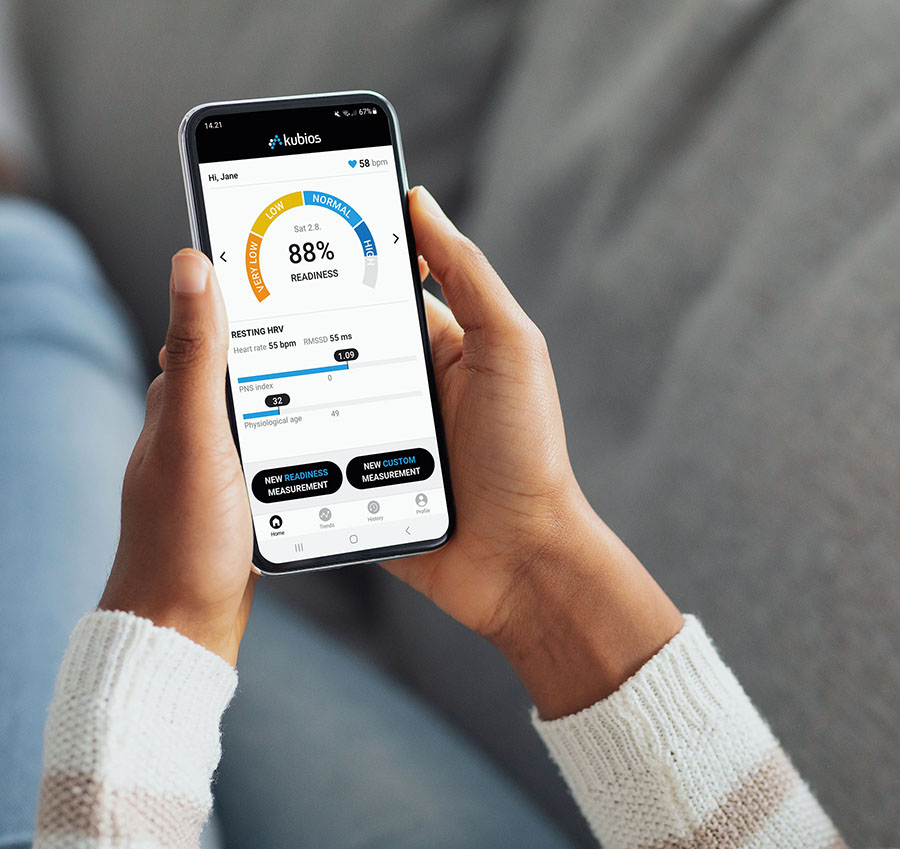
  • If your HRV as a whole stays below your baseline for several days, it usually signals accumulated stress. This can come from hard training, poor sleep, or even daily life pressures. In this case, it’s wise to cut back on training intensity and prioritize recovery, rest, and good nutrition until your numbers normalize [7].
  • If HRV rises above your baseline, it typically means your body is adapting well to recent stress. Higher-than-usual values suggest resilience is improving, and you can safely progress with heavier training loads or more challenging sessions without overreaching [8].
  • Always cross-check the numbers with how you feel.  HRV is valuable, but it’s not the whole story. Fatigue, mood, focus, and sleep quality often reveal just as much as the data [2]. Think of HRV as one side of the picture and your subjective experience as the other — together they provide the most reliable guidance.
HRV and recovery

Making recovery practical

  • Adjust training: Use HRV to guide intensity across the week (heavy vs. light days). When HRV values are low, it’s a clear signal to shift towards active recovery, mobility work, or lighter sessions. On days when HRV is high, you can safely increase effort and push harder, knowing your body is ready. Over time, this approach builds a rhythm that helps avoid both burnout and wasted workouts, while still keeping progress steady [7] ,[8].
  • Breathing & posture drills: Simple diaphragmatic breathing and upright posture can restore vagal tone and improve oxygenation [9]. Even a few minutes of slow, deep breathing after work or training is often enough to reset the nervous system and shift it back into “recovery mode”. Adding posture awareness ensures the diaphragm has space to work properly, making each breath more effective. These drills may look minor, but when practiced regularly, they provide a reliable way to nudge the body back into balance [9].
  • Micro-recovery habits: Short breaks, mindfulness, or even a quick walk can restore balance during busy schedules. These small resets prevent stress from silently building up, keep energy levels steadier across the day, and make it easier to stay consistent over the long run [10]. Done regularly, micro-recoveries act as small anchors that hold recovery and performance together, even when life is hectic.

Why this matters for trainers, professionals, and everyday users

  • Better stress management: HRV shows how well your body is switching between effort and recovery. By following trends, you can catch rising stress before it turns into fatigue—and make small adjustments in time instead of reacting too late. This makes HRV a practical early-warning tool, especially when daily stressors from work or life start to pile up [2].
  • Improved personal performance: Consistently training in line with HRV data helps members avoid burnout and keep energy levels steady. That translates into more productive workouts — and steadier daily performance both in training and outside of it [7], [8]. For professionals, it can mean sharper focus during the workday, while for athletes it often means hitting sessions with more quality rather than just more volume.
  • Consistency over time: Instead of pushing hard every day, HRV-guided recovery creates a sustainable rhythm. This makes it easier to stay on track for the long run, without the ups and downs that come with overtraining or irregular recovery [7]. Over weeks and months, that consistency is what drives meaningful progress — whether the goal is better fitness, more balanced energy, or simply feeling less worn out by everyday demands.

Conclusion – A doctor’s perspective

HRV data is most valuable when kept simple: don’t get lost in every metric, focus on the overall trends [1]. Even a handful of well-chosen measures are enough to guide meaningful, everyday decisions.

When approached this way, HRV becomes more than just data — it turns into a practical tool for balancing stress, building resilience, and sustaining consistent performance [2], [7]. Whether you’re an athlete fine-tuning training, a trainer supporting clients, or simply someone navigating the demands of work and life, HRV can act as a steady compass that points you toward smarter recovery and more sustainable progress.

The bottom line: HRV works best when used as a guide, not a rulebook — helping you see the bigger picture of stress and recovery in daily life.

Antti Rintanen

About the author

Dr. Antti Rintanen is a Finnish medical doctor and Master of Science in engineering, and the author of The Internet Doctor. He focuses on translating scientific insight into practical strategies for recovery, stress balance, and performance, helping people apply evidence-based tools in everyday life.

References 

  1. Shaffer F, Ginsberg JP. An overview of heart rate variability metrics and norms. Front Public Health. 2017;5:258.
  2. Thayer JF, Sternberg E. Beyond heart rate variability: vagal regulation of allostatic systems. Ann N Y Acad Sci. 2006;1088:361-372.
  3. Tarvainen MP, Niskanen JP, Lipponen JA, Ranta-Aho PO, Karjalainen PA. Kubios HRV—heart rate variability analysis software. Comput Methods Programs Biomed. 2014;113(1):210-220.
  4. Nunan D, Sandercock GRH, Brodie DA. A quantitative systematic review of normal values for short-term heart rate variability in healthy adults. Pacing Clin Electrophysiol. 2010;33(11):1407-1417.
  5. Laborde S, Mosley E, Thayer JF. Heart rate variability and cardiac vagal tone in psychophysiological research – recommendations for experiment planning, data analysis, and data reporting. Front Psychol. 2017;8:213.
  6. Billman GE. The LF/HF ratio does not accurately measure cardiac sympatho-vagal balance. Front Physiol. 2013;4:26.
  7. Stanley J, Peake JM, Buchheit M. Cardiac parasympathetic reactivation following exercise: implications for training prescription. Sports Med. 2013;43(12):1259-1277.
  8. Plews DJ, Laursen PB, Stanley J, Kilding AE, Buchheit M. Training adaptation and heart rate variability in elite endurance athletes: opening the door to effective monitoring. Sports Med. 2013;43(9):773-781.
  9. Lehrer P, Gevirtz R. Heart rate variability biofeedback: how and why does it work? Front Psychol. 2014;5:756.
  10. Brosschot JF, Verkuil B, Thayer JF. Conscious and unconscious perseverative cognition: is a large part of prolonged stress due to unconscious stress? J Psychosom Res. 2010;69(4):407-416.