
 Whether you are an individual trying to balance a demanding career and personal life, or a wellness coach guiding clients through high-pressure lifestyles, you know that chronic daily stress is a modern epidemic. But before we can manage stress effectively, we have to understand exactly what it is doing to our bodies
What is stress?
At its core, stress is the body’s physiological and psychological response to any demand for change. As pioneering endocrinologist Hans Selye—often called the “father of stress research”—defined it, stress is the organism’s attempt to maintain balance (homeostasis) when faced with external or internal challenges.
While we often use the word “stress” negatively, it is actually a natural and necessary survival mechanism. In short bursts, stress sharpens our focus, boosts our energy, and helps us tackle difficult tasks. However, when the body’s sympathetic nervous system remains chronically overactivated without adequate time to recover, stress becomes maladaptive and harmful.
Stressors—the triggers that provoke a stress response—come in many forms. Together, they contribute to what wellness professionals call your “total load”:
- Psychological and emotional: Looming work deadlines, financial pressures, interpersonal conflicts, or the pressure to overachieve.
- Physical: Intense physical exertion, chronic illness, poor nutrition, or lack of sleep.
- Environmental: Excessive workplace noise, extreme temperatures, or a chaotic daily environment.
The symptoms of chronic stress may eventually manifest across multiple systems:
- Physical symptoms: Chronic fatigue, tension headaches, muscle stiffness, digestive issues, and elevated blood pressure.
- Psychological symptoms: Anxiety, irritability, brain fog, feeling perpetually overwhelmed, and a loss of motivation.
- Behavioral symptoms: Insomnia or restless sleep, changes in appetite, social withdrawal, and a drop in workplace performance.
The problem is that many of us learn to ignore these symptoms. We push through the warning signs until burnout forces us to stop. The scientific consensus is shifting: stress is not just a psychological feeling; it is a measurable physiological state. Thanks to decades of research in physiology and occupational medicine, we now know that heart rate variability (HRV) is one of the most reliable, objective biomarkers for tracking how our bodies respond to—and recover from—daily stressors[1], [2], [3].
The brain-heart connection: How stress alters your rhythm
To understand why HRV is such a powerful tool, we have to look at the autonomic nervous system (ANS), which operates in two main modes:
- The sympathetic nervous system (SNS): Your body’s “fight or flight” accelerator, activated during physical exertion or mental stress.
- The parasympathetic nervous system (PNS): Your body’s “rest and digest” brake, driven largely by the vagus nerve, which helps you recover and calm down.
When you are healthy and well-recovered, your heart does not beat like a metronome. This natural, healthy variation in the milliseconds between each heartbeat is known as heart rate variability. High HRV indicates that your parasympathetic “brake” is actively making micro-adjustments, showing that your body is resilient and ready to adapt to environmental demands.
However, when the brain perceives chronic threats—like looming deadlines or financial pressure—it suppresses that parasympathetic brake. The SNS takes over, heartbeats become more rigidly regular, and HRV drops. In short, a chronically low HRV is a physiological red flag that your body’s homeostatic balance is disrupted.
Daily stress, overcommitment, and HRV
The modern workplace frequently demands prolonged mental effort without adequate physical recovery. In stress research, HRV is increasingly used to assess this specific type of mental and physical workload.
In general, heightened daily stress is associated with lowered HRV, specifically with reduced parasympathetic activation [1]. This has been observed as decreases in RMSSD, a common index of beat-to-beat variability. It is also reflected by an elevated ratio of low-frequency to high-frequency HRV (an increase in the LF/HF ratio), indicating a shift in the sympathovagal balance towards sympathetic nervous system dominance. Furthermore, “work overcommitment”—the tendency to sacrifice personal time, work excessive overtime, and constantly think about work problems even when at home—may exacerbate these changes in HRV and lead to burnout [4]. While work is often the primary driver, balancing these intense professional demands with family and personal responsibilities compounds the overall stress load.
Burnout, therefore, is not a sudden event. The general adaptation syndrome (GAS), developed by Hans Selye [5], describes the body’s short- and long-term, three-stage physiological response to stress:
- Alarm: The initial “fight or flight” reaction to a stressor, where the sympathetic nervous system is activated to prepare the body for action. During this acute phase, HRV typically drops as the parasympathetic nerve activity is suppressed.
- Resistance: The parasympathetic nervous system attempts to restore physiological functions to normal. However, the body continues to focus its resources against the stressor, keeping stress hormones elevated even while the individual appears outwardly normal. While HRV might initially stabilize during this stage, it often begins to steadily decline toward the end of this phase as the body’s capacity to cope is pushed to its absolute limits.
- Exhaustion: If the stressor continues beyond the body’s capacity to cope, the acquired adaptation is lost. The body’s resources become fully depleted, leading to chronic fatigue, burnout, and health issues. At this point, HRV remains chronically suppressed, reflecting deep autonomic fatigue and a severely compromised ability to recover.
The hidden danger: Spending time in the ‘Resistance’ stage is a normal part of adapting to a demanding life. The danger arises when people operate near the threshold of exhaustion for prolonged periods. Even if they feel fine and push through, their autonomic nervous system is silently struggling. Crucially, HRV typically drops during this late resistance phase, acting as an early warning that physiological reserves are depleting. This objective data allows individuals to intervene proactively and prevent full-blown burnout.
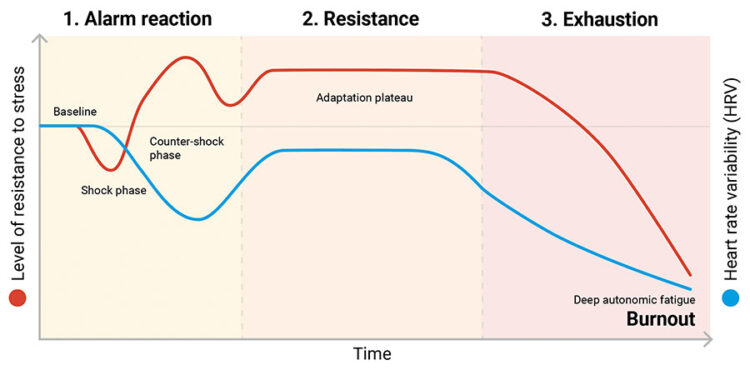
Figure: Selye’s General Adaptation Syndrome (GAS) and the corresponding changes in HRV across the three stages of chronic stress.
Why subjective feelings aren’t enough
Relying solely on how one feels can be misleading. People with high “work overcommitment” often normalize their fatigue. They ignore poor sleep and power through their days with caffeine and willpower. Because relying on subjective feelings depends entirely on an individual’s conscious perception of their own well-being, it can easily miss the silent, underlying strain accumulating in the autonomic nervous system. By the time subjective symptoms like severe insomnia, irritability, or cardiovascular issues become undeniable, the body has already entered the exhaustion stage. This is why objective monitoring is no longer just for elite athletes; it is a vital preventative tool for everyday health and wellness.
How to objectively monitor stress and recovery
While a 24-hour HRV recording might seem like the most comprehensive way to track stress, it is actually heavily contaminated by the “noise” of daily life. Activities like talking, eating, moving, and changing posture constantly influence your HRV, making it incredibly difficult to isolate your actual physiological baseline. Instead, taking short, standardized resting measurements (e.g., 3 to 5 minutes) daily is widely considered a preferred approach. By measuring your HRV at the same time every day under resting conditions, you eliminate these external variables and capture a highly reliable, longitudinal picture of your autonomic health.
You do not need a laboratory to get these insights. Kubios has translated this gold-standard science into practical tools for everyday use:
- For Individuals: The Kubios HRV app allows you to measure your daily readiness in just a few minutes using only your smartphone (see how it works), or by pairing the app with a compatible chest strap heart rate sensor. By taking a short resting measurement each morning, you receive an objective Readiness Index that tells you exactly how your nervous system is handling your current lifestyle load, helping you make informed choices about your daily activity and rest.
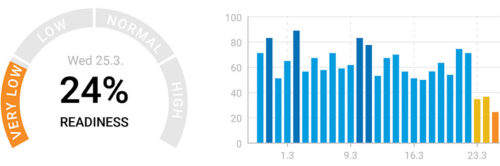
Figure: Monitoring daily readiness with Kubios HRV app.
- For Wellness Coaches and Professionals: The Kubios HRV Team Readiness software provides a comprehensive daily dashboard of your clients’ physiological states. Instead of guessing if a client is adapting well to daily stressors, you can monitor longitudinal trends in their autonomic health and spot any emerging acute or chronic fatigue. If their HRV begins to steadily drop despite their self-reported “good mood,” you have the objective data needed to intervene, adjust their wellness plan, and prevent chronic burnout before it happens.
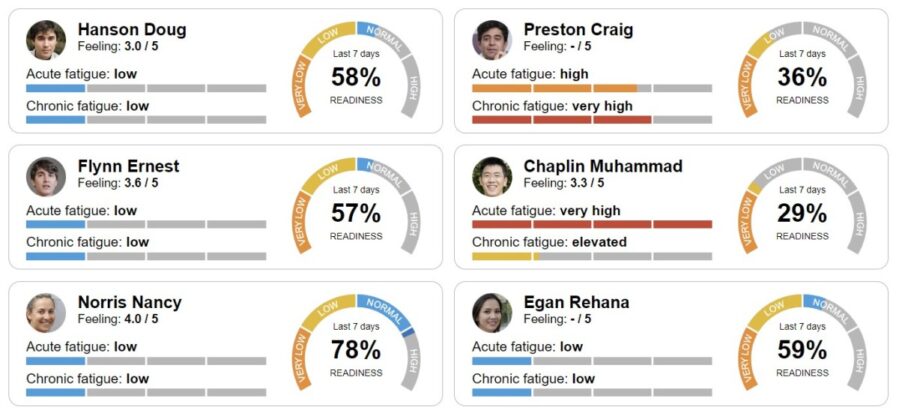
Figure: Monitoring daily readiness and fatigue with Kubios HRV Team Readiness.
Daily stress might be unavoidable, but burnout doesn’t have to be. By utilizing scientifically validated HRV analytics, we can finally make the invisible toll of stress visible—and take actionable steps toward true recovery.
Are you ready to stop guessing and start measuring? 👉 Download the Kubios HRV app today to track your personal daily readiness, or visit our Team Readiness page to book a live demo and see how objective physiological data can transform your wellness coaching practice.
Frequently asked question (FAQ)
What is Heart Rate Variability (HRV) and why does it matter for stress?
Heart rate variability (HRV) is the natural variation in the time (measured in milliseconds) between consecutive heartbeats. It is a highly reliable, objective biomarker of your autonomic nervous system. A high HRV generally indicates that your body is well-recovered and resilient, while a chronically low HRV is a physiological red flag that your body is experiencing prolonged stress or fatigue. It is important to note that resting HRV is highly individual and naturally decreases with age. Because of this, it is best to track your own personal baseline over time. To learn more about what numbers to expect based on your demographic, check out our guide on heart rate variability normal ranges.
Why does my HRV drop when I am stressed?
When your brain perceives chronic threats—like looming deadlines, heavy workloads, or financial pressure—it activates your sympathetic nervous system (your “fight or flight” mode) and suppresses your parasympathetic nervous system (your “rest and digest” brake). This may slightly elevate your resting heart rate, but more importantly, it decreases your HRV as your heart beats more like a rigid metronome, signalling a disruption in your body’s natural balance.
Can’t I just rely on how I feel to know if I am burned out?
While subjective feelings and validated questionnaires are helpful for gathering context, they have a major limitation: human perception. People routinely normalize their own fatigue and power through stress using caffeine and willpower. By the time you actually feel severe symptoms like insomnia or chronic exhaustion, your body has already entered the burnout stage. HRV provides an objective, early-warning system before those symptoms become undeniable.
Do I need to track my HRV 24 hours a day to get accurate results?
No. In fact, 24-hour recordings are heavily contaminated by the “noise” of daily life, such as talking, eating, moving, and changing posture. By taking a short, standardized resting measurement (e.g., 3 to 5 minutes) at the same time each morning, you can eliminate external variables and thereby achieve a much more reliable, accurate baseline of your true recovery status. Short daily resting HRV measurements are also very convenient for tracking your stress levels over the long term, e.g., over several months or years.
How can I start measuring my HRV to prevent burnout?
You don’t need a laboratory to get started. Individuals can use the Kubios HRV app to take a short daily resting measurement using just a smartphone (which uses the phone’s built-in accelerometer sensor to accurately detect your heartbeats), or by pairing the app with a compatible chest strap HR sensor. This provides a daily Readiness Index to help you manage your daily load. For wellness professionals, the Kubios HRV Team Readiness software offers a comprehensive dashboard to monitor clients’ longitudinal trends, spot emerging fatigue, and adjust wellness plans proactively.
References
- Järvelin-Pasanen S, Sinikallio S, and Tarvainen MP. Heart rate variability and occupational stress–systematic review. Industrial Health, 56:500-511, 2018.
- Kim HG, Cheon EJ, Bai DS, Lee YH, Koo BH. Stress and heart rate variability: A meta-analysis and review of the literature. Psychiatry Investig, 15(3):235-245, 2018.
- Sammito S, Thielmann B, Klussmann A, Deußen A, Braumann KM, Böckelmann I. Guideline for the application of heart rate and heart rate variability in occupational medicine and occupational health science. J Occup Med Toxicol, 19(1):15, 2024.
- Lo EV, Wei YH, Hwang BF. Association between occupational burnout and heart rate variability: A pilot study in a high-tech company in Taiwan. Medicine (Baltimore), 99(2):e18630, 2020.
- Selye H. Stress in Health and Disease. Boston: Butterworths; 1976.